Statistical Analysis
The image statistics functions assist with understanding the dataset. These can be used to get a big picture view of the dataset and it’s underlying distribution. These functions create the data distribution that the Outlier class uses to identify outliers.
What are the statistical analysis functions
There are seven different DataEval stat functions for analyzing a dataset:
boxratiostatsdimensionstatshashstatsimagestatslabelstatspixelstatsvisualstats
The information below includes what each function does and the statistical analysis metrics that are included in each function.
boxratiostats
The boxratiostats() function calculates the ratio of the bounding box
outputs to the image outputs.
This function can be used with the output from:
dimensionstats
pixelstats
visualstats
This function requires both a bounding box output and an image output from the above mentioned stat functions.
This function can be used in conjunction with the Outliers class to determine if there are any issues with any of the images in the dataset.
imagestats
The imagestats() function provides an easy way to run the
dimensionstats, pixelstats, and visualstats on the images of a dataset or the
pixelstats, and visualstats over each channel of the images of a dataset.
dimensionstats
The dimensionstats() function is an aggregate metric that calculates
various dimension based statistics for each individual image:
channels
height
width
size - width * height
aspect_ratio - width / height
depth - automatic calculation of the bit depth of the image based on max and min image values
left - the x value (in pixels) of the top left corner of the image or bounding box
top - the y value (in pixels) of the top left corner of the image or bounding box
center - the x and y value (in pixels) of the center of the image or bounding box
distance - the distance between the center of the image and the center of the bounding box
This function expects the image in a CxHxW format and uses this standard format to populate the width, height and channels metrics.
This function can be used in conjunction with the Outliers class to determine if there are any issues with any of the images in the dataset.
hashstats
The hashstats() function is an aggregate metric that calculates various
hash values for each individual image:
This function can be used in conjunction with the Duplicates class in order to identify duplicate images.
labelstats
The labelstats() function provides summary statistics across classes
and labels:
label_counts_per_class - total number of labels for each class
label_counts_per_image - total number of labels for each image
image_counts_per_label - total number of images for each label
image_indices_per_label - dictionary tracking image number for each label
image_count - total number of images
label_count - total number of labels
class_count - total number of class
pixelstats
The pixelstats() function is an aggregate metric that calculates normal
statistics about pixel values for each individual image:
mean - average pixel value across entire image
std - standard deviation of pixel values across entire image
var - variance of pixel values across entire image
skew - measure of how normally distributed the data is
kurtosis - measure of how normally distributed the data is
entropy - Shannon entropy based on the histogram, \(-\sum p \log p\)
histogram - scales pixel values between 0-1 and binned into 256 bins
This function can be used in conjunction with the Outliers class to determine if there are any issues with any of the images in the dataset.
visualstats
The visualstats() function is an aggregate metric that calculates visual
quality statistics for each individual image:
brightness - the value of the 25th percentile
sharpness - the standard deviation of a 3x3 edge filter
contrast - max value - min value / mean value
darkness - the value of the 75th percentile
missing - total number of pixels missing a value as a percentage of total pixels
zeros - total number of pixels with a zero value as a percentage of total pixels
percentiles - 0, 25, 50, 75, 100 percentile values
This function can be used in conjunction with the Outliers class to determine if there are any issues with any of the images in the dataset.
When to use the statistical analysis functions
The functions are automatically called when using Outliers.evaluate on data.
Therefore, the functions themselves don’t usually need to be called on the data.
However, there are a few scenarios that lend themselves to using the functions
independently:
When multiple sets of data as well as the combined set are to be analyzed, it can be easier to run the stat functions on each individual set of data and then pass in the outputs to the Outlier class in each of the desired data combinations for analysis.
When comparing the resulting data distribution between two or more datasets to determine how similar the datasets are.
When visualizing the resulting data distribution after using one or more of the stat functions.
Example visualizing the resulting data distribution
The output for each function contains a plot function which plots
a histogram of the data results, except for the hashstats function whose
results are grouped lists and has no visualization function, and the
labelstats function whose results can be visualized instead with the
to_table function.
Example code and result for the datasetstats function:
# Load the statistic metric from DataEval
from dataeval.metrics.stats import datasetstats

# Loading in the PASCAL VOC 2011 dataset for this example
to_tensor = v2.ToImage()
ds = VOCDetection(
    "./data",
    year="2011",
    image_set="train",
    download=True,
    transform=to_tensor,
)

# This stat function takes about 1-3 minutes to run depending on your hardware

# Calculate the datasetstats for the images
# Note: the stat function expects the images as an iterable
#       and in the (C,H,W) format
stats = datasetstats(d[0] for d in ds)

# Visualize the results
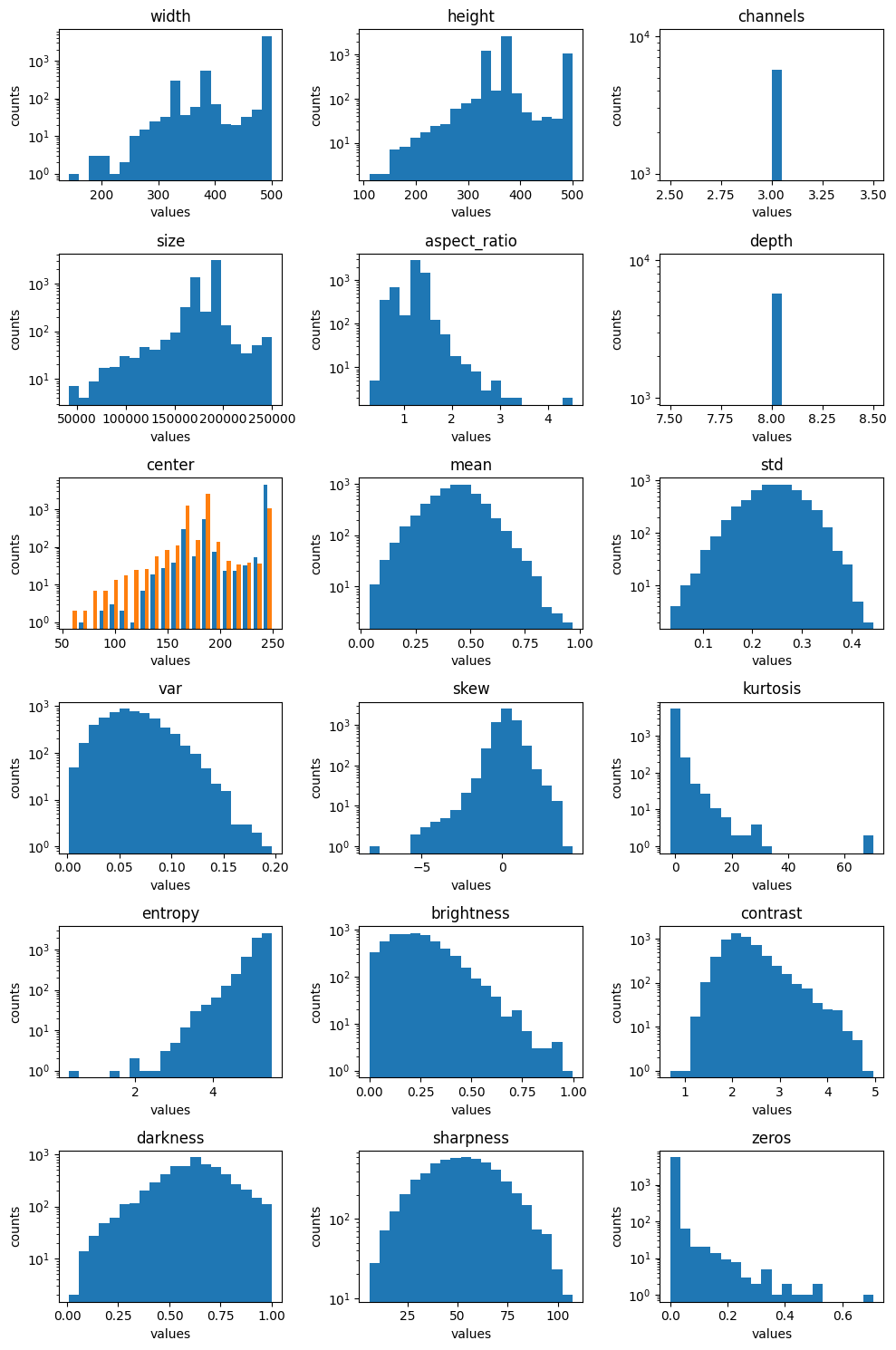
stats.plot(log=True)
Example code and result for the channelstats function:
# Load the statistic metric from DataEval
from dataeval.metrics.stats import channelstats

# Loading in the PASCAL VOC 2011 dataset for this example
to_tensor = v2.ToImage()
ds = VOCDetection(
    "./data",
    year="2011",
    image_set="train",
    download=True,
    transform=to_tensor,
)

# This stat function takes about 1-3 minutes to run depending on your hardware

# Calculate the datasetstats for the images
# Note: the stat function expects the images as an iterable
#       and in the (C,H,W) format
ch_stats = channelstats(d[0] for d in ds)

# Visualize the results
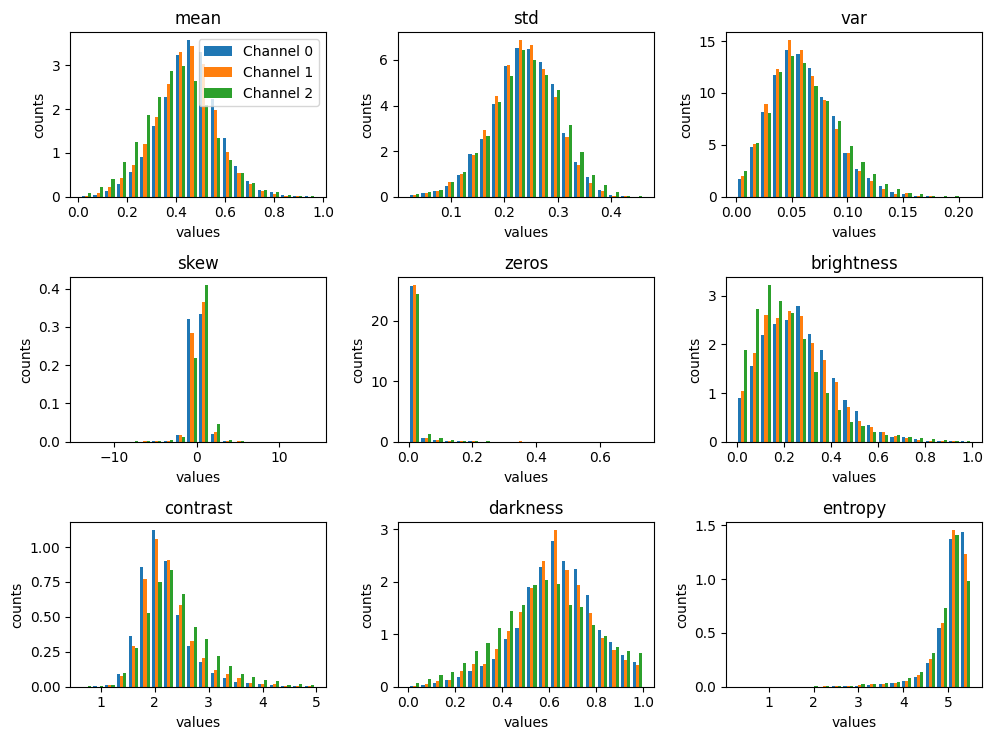
ch_stats.plot(log=False, channel_limit=3)
Using the visualization for a quick analysis
Visualizing the distribution of values for each metric allows one to quickly inspect the metrics for unusual distributions. In general, each metric should follow either a normal distribution or a uniform distribution.
With a uniform distribution, you want to notice if any of the plots have areas that are a lot shorter or a lot taller than the rest of the values.
With a normal distribution, you are looking at the edges of the bell curve to see if the values near the edges of the plot raise up or if there are gaps between the edge values and the next value in.
When analyzing the visualizations by channel, you should not be interested in the overall shape of these plots but in the comparison of the shape across each of the individual channels. You want to see if the same shape holds across each channel or if there are large differences between the channels. This is important because discrepancies across channels can help detect image processing errors and channel bias.
For example, below is a quick analysis of the above example plots.
In regards to the datasetstats plot, there are a few key insights:
The channel metric has only one value, 3, which is interesting since some of the images in the dataset are greyscale, and greyscale images usually only have 1 channel.
The entropy, zeros, kurtosis, and contrast metrics are single-tailed and all of them have a long tail which indicates that the images whose values are in the edges of the tail are potentially problematic.
Size, aspect ratio, variance, skew, brightness and darkness have skewed or off-center distributions which is another sign of problematic images.
Mean, standard deviation and sharpness appear to have a normal distribution and none have an extended tail, which is a good sign.
While these insights don’t identify the exact images that may be problematic, they highlight where to focus on with further analysis.
In regards to the channelstats plot, the only insight is that there is very little difference across the channels for each metric. Therefore, there are no additional concerns beyond those from the datasetstats plot.