Bayes Error Rate
What is it
Bayes Error Rate or BER refers to the
irreducible error in a particular
classification problem. The ber function assesses the
feasibility of a machine learning classification task by
estimating this error rate. Bayes error rate has a formal definition given by
the following:
Put into words, it is the misclassification rate of the best possible classifier.
When to use it
The ber metric should be used when you would like to measure the
feasibility of a
machine learning
classification task.
For example, you would like to know if the operational
accuracy requirement of 80% is achievable given the imagery.
This quantity is of interest because it informs an engineer about the inherent difficulty of a problem. If this difficulty surpasses operational performance requirements, then the problem must be changed in order to become feasible.
Theory behind it
While the expectation described above is easy to write down, it is nontrivial to obtain it for difficult computer vision tasks. Many works have proposed estimators of this quantity and analyzed their properties. At their core, these estimators try to quantify uncertainty along the decision boundary. For high dimensional datasets, typically only a fraction of samples are inherently problematic when it comes to classification. For example, take the following problematic images from the MNIST dataset (difficult images taken from this kaggle notebook):
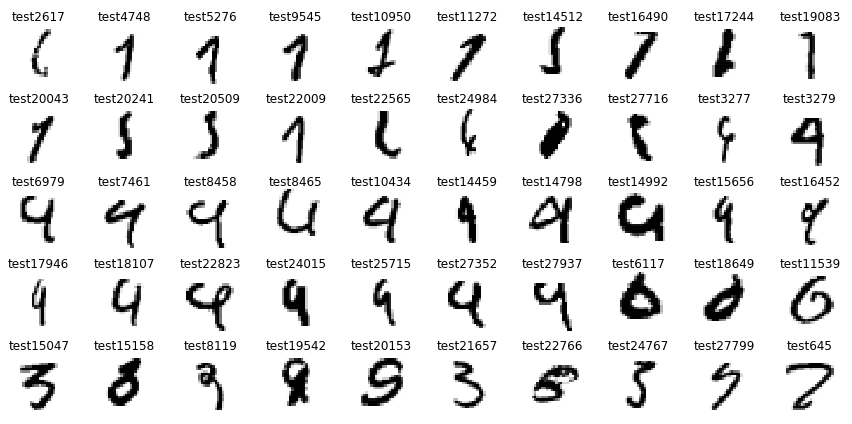
It is very difficult for even a human to classify these images, and the
conditional distributions of labels for them are certainly non-deterministic.
This is an intuitive example of the
irreducible error that the ber function estimates.
One way of understanding how we try to estimate BER is to look at dimension reductions of the images. In this case, we use UMAP (a simple dimension reduction technique) to embed the MNIST images in 2-dimensional space.
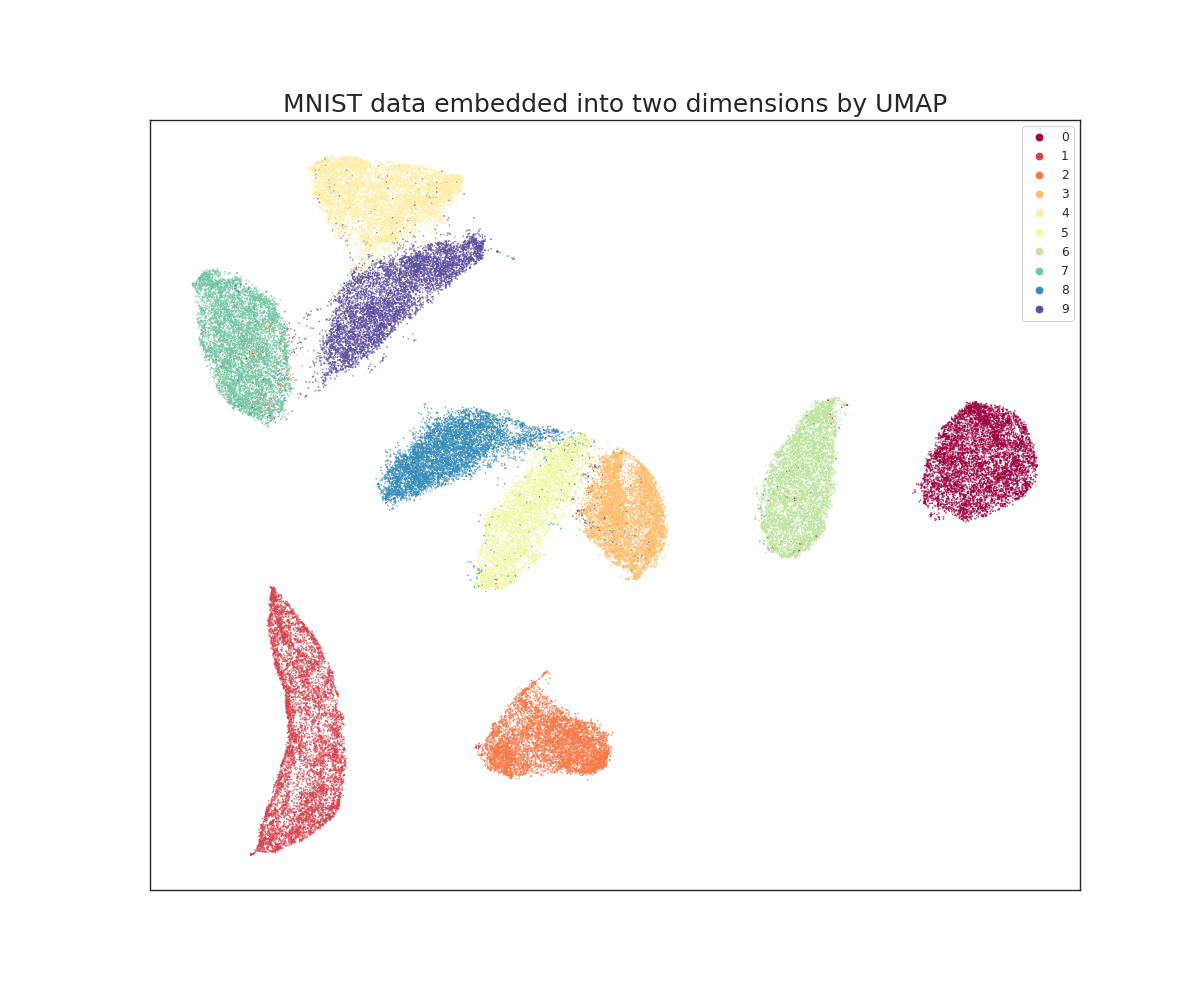
Here the colors represent the different labels (digits). While most are separated, a small fraction of them are in the wrong cluster or lie in the overlapping regions between clusters. These are the samples that contribute to irreducible error.
The two methods we use to estimate BER are K-nearest-neighbors and a minimum spanning tree. The technical details behind these estimators are drawn from Learning to Bound the Multi-class Bayes Error. You can read this paper for more technical details and justification pertaining to its estimation.
The ber() API will give more information on how to use the
functionality. The only parameter which is up to the user to select is \(k\), the
number of neighbors to use for the BER estimator. We recommend \(k=5\) as a
default. There are other options, such as \(k=\sqrt{n}\) or \(k=c_0 n^{4/(4+d)}\),
where \(d\) is the number of features/dimension of the embedding, n is the
sample size, and \(c_0\) is some constant. Both of these have empirical and
theoretical merits, but for most users, a relatively small, fixed \(k\) is best.