Out of distribution data
What is out-of-distribution (OOD)?
Out-of-Distribution (OOD) refers to data samples that deviate significantly from the statistical patterns of the reference dataset used to train a model.
In unsupervised anomaly detection, the model learns the “normal” patterns from a reference training set (In-Distribution). When it encounters operational data that does not conform to these learned patterns, it flags them as outliers.
OOD data typically falls into two categories:
Structural Anomalies: The input is corrupted, broken, or contains localized defects (e.g., a scratch on a product surface, sensor noise, or digital artifacts).
Semantic Shift: The input represents a valid object or state that simply belongs to a class not seen during training (e.g., a “walking” motion in a dataset consisting only of “running”).
When to use OOD detection
OOD detection methods should be used when you need to identify individual samples in a dataset that are qualitatively different from those in a reference (training) dataset. Typical use cases include:
Operational Monitoring: Determining if new operational data contains samples significantly different from training data
Data Quality Control: Identifying corrupted, damaged, or anomalous samples in production pipelines
Novel Class Detection: Finding operationally relevant classes or sub-classes not present in training data
Model Reliability: Preventing model degradation when novel samples represent a significant portion of operational data
This type of detection is critical because models are likely to degrade rapidly if OOD data represents a significant portion of operational inputs.
Two fundamental approaches
DataEval provides two conceptual frameworks for OOD detection, each with distinct strengths and computational characteristics:
Reconstruction-based detection
Core Principle: Learn to recreate the data.
Reconstruction-based methods work by learning a compressed representation of the normal data distribution and attempting to reconstruct input samples. The fundamental assumption is that the model will successfully reconstruct in-distribution samples but fail to accurately reconstruct OOD samples that lie outside the learned manifold.
How it works:
The model learns to compress high-dimensional input data into a lower-dimensional latent representation
It then attempts to reconstruct the original input from this compressed form
The reconstruction error (difference between input and output) serves as the OOD score
High reconstruction error indicates the sample is likely OOD
Key characteristics:
Requires training a neural network model on reference data
Learns the underlying structure and patterns of the data distribution
Can capture complex, non-linear relationships in the data
Provides both instance-level and feature-level anomaly scores
Training time ranges from moderate to high depending on model complexity
DataEval Implementation: OODReconstruction
Distance-based detection (K-nearest neighbors)
Core Principle: Measure proximity to known examples.
Distance-based methods operate directly on pre-computed feature embeddings, using the principle that OOD samples will be far from normal samples in embedding space. Rather than learning to reconstruct data, these methods memorize the reference distribution and compare new samples against it.
How it works:
Reference embeddings from normal data are stored or indexed
For each new sample, the method computes distances to its nearest neighbors in the reference set
Samples far from their nearest neighbors are considered OOD
The average distance to k-nearest neighbors serves as the OOD score
Key characteristics:
Requires pre-computed embeddings (from a separate feature extractor)
No neural network training required - non-parametric approach
Fast to “fit” (just indexes the reference embeddings)
Fast inference using efficient nearest neighbor search
Assumes embeddings capture meaningful semantic similarity
Provides only instance-level scores
DataEval Implementation: OODKNeighbors
Reconstruction-based methods in detail
Different reconstruction architectures are suited for different types of OOD
data. DataEval’s OODReconstruction class supports multiple architectures that
can be automatically detected or explicitly specified.
Autoencoder (AE)
Mechanism: Reconstruction Error.
An Autoencoder compresses high-dimensional input data into a lower-dimensional latent vector and attempts to reconstruct it back to the original input.
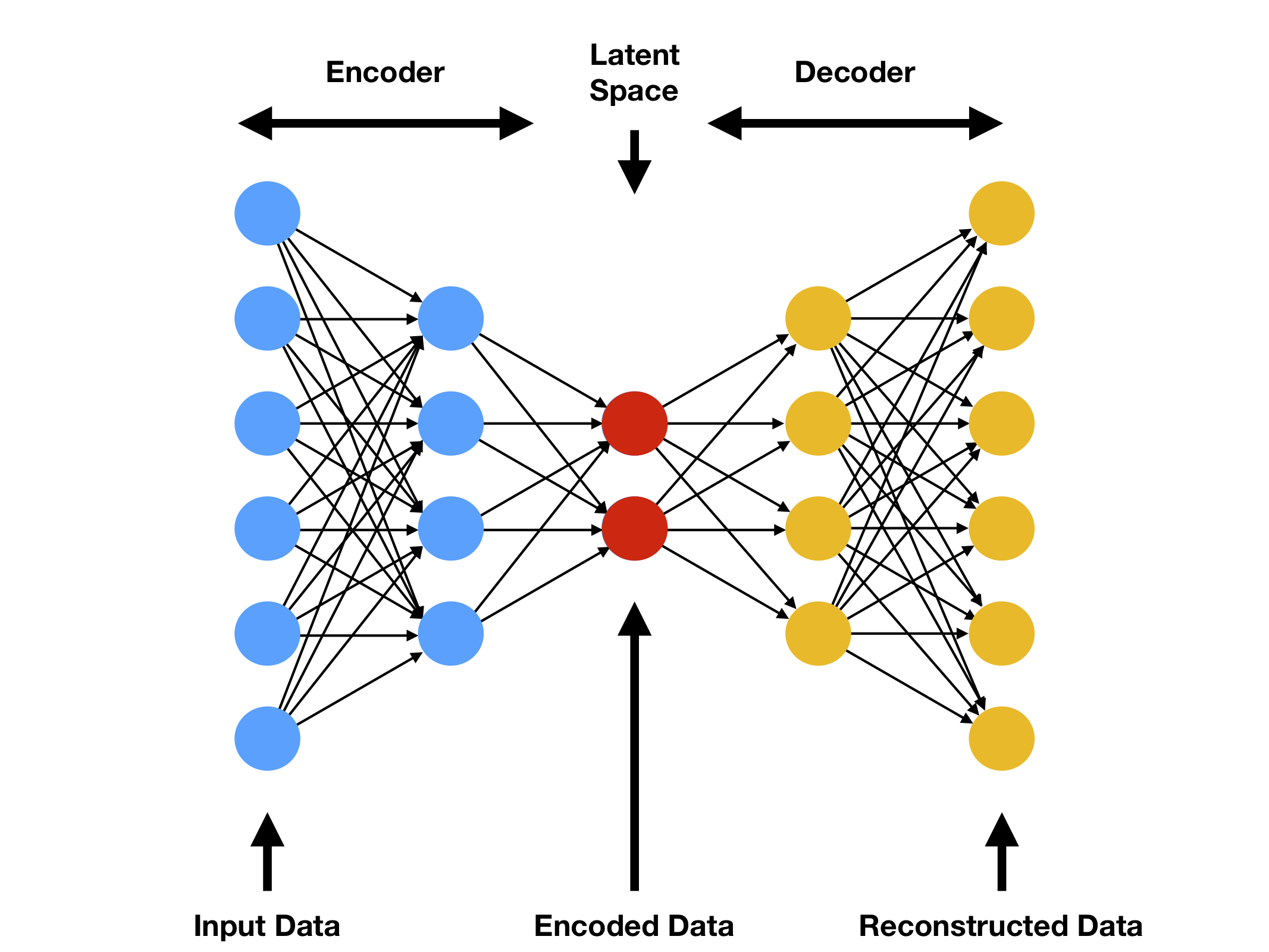 (https://www.compthree.com/blog/autoencoder/)
Theory: The model learns the specific “manifold” (structure) of the training data. If it encounters an OOD sample, it fails to compress and reconstruct it accurately because it lacks the learned features to describe that specific anomaly.
Metric: Mean Squared Error (MSE) between the input and the reconstruction.
Latent Space: Deterministic encoding - each input maps to a single point in latent space.
Best For: Structural defects like cracks, noise, corruptions, or broken parts.
Variational autoencoder (VAE)
Mechanism: Probabilistic Likelihood (ELBO).
A VAE adds a probabilistic constraint to the latent space, forcing the latent vectors to follow a continuous distribution (usually a Standard Normal distribution).
Theory: While standard AEs only care about reconstruction accuracy, VAEs also care about how “likely” a data point is to occur under the model’s learned probability distribution. It regularizes the latent space to be smooth and continuous.
Metric: Evidence Lower Bound (ELBO). A low ELBO score indicates the sample is statistically improbable.
Latent Space: Probabilistic encoding - each input is encoded as a distribution (mean and variance), introducing controlled randomness.
Best For: Probabilistic shifts, noisy biological data, or subtle statistical shifts.
AE/VAE with GMM (deep mixture models)
Mechanism: Density Estimation & Energy.
These models combine the dimensionality reduction of an autoencoder with the clustering capability of a Gaussian Mixture Model (GMM).
Theory: Real-world data is often multimodal (e.g., distinct clusters for “Day Mode” vs. “Night Mode”). A standard AE or VAE attempts to compress these into a single distribution center. By adding a GMM, the model explicitly learns multiple distinct “centers” of density in the latent space.
Metric: A combined score of Reconstruction Error (structure) + GMM Energy (density). The GMM energy measures how well a sample fits into one of the learned Gaussian components. Scores are combined using sensor fusion (z-score normalization and weighted combination).
Latent Space: Explicitly modeled as a mixture of Gaussians, where each component represents a distinct mode in the data.
Best For: Multimodal data with distinct sub-populations (e.g., different machine operating speeds, day/night imagery).
Configuration: The OODReconstructionConfig class allows tuning of score
fusion parameters:
gmm_weight: Weight for GMM component (default 0.5, range [0, 1])gmm_score_mode: Fusion method (“standardized” or “percentile”)
Distance-based methods in detail
K-nearest neighbors (KNN) in embedding space
Mechanism: Proximity to Reference Samples.
The OODKNeighbors detector works by computing how far a test sample is from
its nearest neighbors in a reference set of normal embeddings.
Theory: The assumption is that in-distribution samples form dense clusters in embedding space, while OOD samples lie in sparse regions far from these clusters. The method leverages pre-trained feature extractors (e.g., from supervised learning, self-supervised learning, or foundation models) that map inputs to meaningful embeddings.
Distance Metrics:
Cosine Distance: Measures angular similarity, effective when embeddings are normalized or direction matters more than magnitude.
Euclidean Distance: Measures absolute distance in embedding space, effective when magnitude represents meaningful differences.
How to use:
from dataeval.shift import OODKNeighbors
from dataeval import Embeddings

# Create embeddings using a pre-trained model
train_emb = Embeddings(train_data, model=your_model)
test_emb = Embeddings(test_data, model=your_model)

# Fit detector and predict
detector = OODKNeighbors(k=10, distance_metric="cosine")
detector.fit(train_emb, threshold_perc=95.0)
result = detector.predict(test_emb)
Advantages:
Training-free: No neural network optimization required
Fast inference: Modern KNN libraries use efficient indexing
Interpretable: Scores directly correspond to distance in embedding space
Flexible: Works with any embedding source (ResNet, CLIP, DINO, etc.)
Considerations:
Embedding quality: Performance heavily depends on the quality of the pre-trained embeddings
Dimensionality: High-dimensional embeddings may suffer from curse of dimensionality
Memory: Requires storing or indexing all reference embeddings
Choice of k: Too small may be sensitive to noise, too large may miss local structure
Comparison of approaches
High-level comparison: Reconstruction vs. distance
Aspect |
Reconstruction-Based |
Distance-Based |
|---|---|---|
Training Required |
Yes - trains neural network on reference data |
No - only indexes reference embeddings |
Input Type |
Raw data (images, signals, etc.) |
Pre-computed embeddings |
Metric |
Reconstruction error (and optionally density) |
Distance to nearest neighbors |
Latent Space |
Learned during training |
Pre-defined by feature extractor |
Computational Cost |
High training, medium inference |
Low “training”, fast inference |
Interpretability |
Feature-level anomaly maps available |
Instance-level scores only |
Best For |
Learning task-specific representations |
Leveraging pre-trained embeddings |
Reconstruction methods comparison
Feature |
Standard Autoencoder |
Variational Autoencoder (VAE) |
GMM-Based AE/VAE |
|---|---|---|---|
Primary Metric |
Reconstruction Error |
ELBO (Likelihood) |
Reconstruction Error + GMM Energy |
Best For |
Structural defects, cracks, corruptions |
Probabilistic shifts, subtle statistical variations |
Multimodal data with distinct sub-populations |
Detection Type |
Deterministic (Is it broken?) |
Probabilistic (Is it rare?) |
Density-Based (Is it in the wrong cluster?) |
Latent Space |
Point estimates (deterministic) |
Probabilistic distributions |
Mixture of Gaussians |
Complexity |
Low training cost, fast inference |
Medium cost, needs more epochs |
High training cost, requires careful tuning |
Choosing the right approach
When to use reconstruction-based methods
Use OODReconstruction when:
You have sufficient training data representing normal behavior
You need to understand where anomalies occur (feature-level detection)
You want to learn task-specific representations
You don’t have access to pre-trained embeddings
Your data has complex structural patterns that need to be learned
Example use cases:
Manufacturing quality control (detecting defects in product images)
Medical imaging (identifying abnormal tissue structures)
Sensor data analysis (detecting equipment malfunctions)
When to use distance-based methods
Use OODKNeighbors when:
You have high-quality pre-trained embeddings available
You want fast deployment without model training
You need very fast inference times
Your reference dataset is too small to train a reconstruction model
You’re working with domains where foundation models provide strong embeddings (e.g., natural images with CLIP/DINO)
Example use cases:
Content moderation (flagging unusual images using CLIP embeddings)
Ecological monitoring (detecting rare species in wildlife camera traps)
Zero-shot OOD detection (leveraging pre-trained vision models)
Hybrid approach
In practice, both approaches can be complementary:
Two-stage detection: Use distance-based methods for fast initial screening, then apply reconstruction-based methods for detailed analysis of flagged samples
Ensemble methods: Combine scores from both approaches for more robust detection
Feature extraction + reconstruction: Use a pre-trained encoder as the embedding source, then train only a lightweight decoder for reconstruction-based scoring
Tutorials and further reading
For hands-on examples and detailed comparisons:
Identify Out-of-Distribution Samples Tutorial - Comprehensive comparison of all methods on MNIST digits
For related concepts:
References
[2] Kuan, J., & Mueller, J. (2022). Back to the Basics: Revisiting Out-of-Distribution Detection Baselines. arXiv preprint arXiv:2207.03061.