Drift Detection Tutorial Using Multiple Drift Detectors#
Problem Statement#
When evaluating and monitoring data after model deployment, it is important to test incoming data for potential drift which may affect model performance.
When to use#
The dataeval.detectors drift detection classes should be used when you would like to measure new data for operational drift.
What you will need#
A set of image embeddings for each dataset (usually obtained with an AutoEncoder)
A python environment with the following packages installed:
dataeval[torch]ordataeval[all]tensorflow-datasets
Setting up#
Let’s import the required libraries needed to set up a minimal working example
from functools import partial

import numpy as np
import tensorflow_datasets as tfds
import torch

from dataeval.detectors.drift import (
    DriftCVM,
    DriftKS,
    DriftMMD,
    preprocess_drift,
)
from dataeval.torch.models import AriaAutoencoder

device = "cuda" if torch.cuda.is_available() else "cpu"
Loading in data#
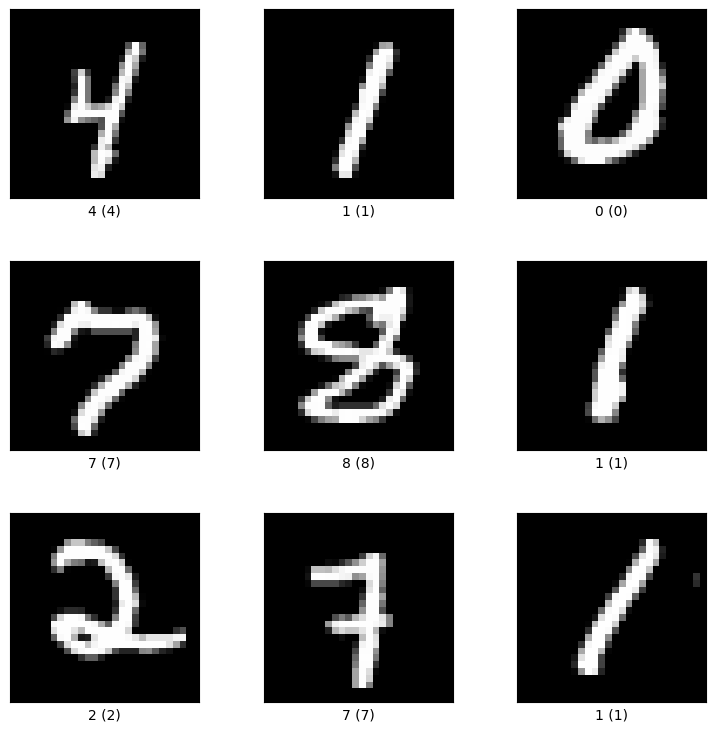
Let’s start by loading in tensorflow’s MNIST dataset, then we will examine it.
# Load in the mnist dataset from tensorflow datasets
dataset, ds_info = tfds.load(
    "mnist",
    split="train[:4000]",
    with_info=True,
)
tfds.visualization.show_examples(dataset, ds_info)
dataset = dataset.shuffle(dataset.cardinality())
dataset = [i["image"] for i in dataset]
dataset = np.array(dataset, dtype=np.float32).transpose(0, 3, 1, 2)
print("Number of samples: ", len(dataset))
print("Image shape:", dataset[0].shape)
Number of samples:  4000
Image shape: (1, 28, 28)
Test reference against control#
Let’s check for drift between the first 2000 images and the second 2000 images from this sample.
data_reference = dataset[0:2000]
data_control = dataset[2000:]
In order to reduce the dimensionality of the data, we can set a simple Autoencoder to the preprocess_fn. While this is optional for the MNIST data set, it is highly recommended for datasets that have higher dimensionality.
For the purposes of the tutorial, we will use 3 forms of drift detectors: Maximum Mean Discrepancy (MMD), Cramér-von Mises (CVM), and Kolmogorov-Smirnov (KS).
# define encoder
encoder_net = AriaAutoencoder(1).encoder.to(device)

# define preprocessing function
preprocess_fn = partial(preprocess_drift, model=encoder_net, batch_size=64, device=device)

# initialise drift detectors
detectors = [detector(data_reference, preprocess_fn=preprocess_fn) for detector in [DriftMMD, DriftCVM, DriftKS]]
We estimate that the test for drift is false for all detectors as both the reference and test data set is from the same MNIST training dataset.
[(type(detector).__name__, detector.predict(data_control).is_drift) for detector in detectors]
[('DriftMMD', False), ('DriftCVM', False), ('DriftKS', False)]
Loading in corrupted data#
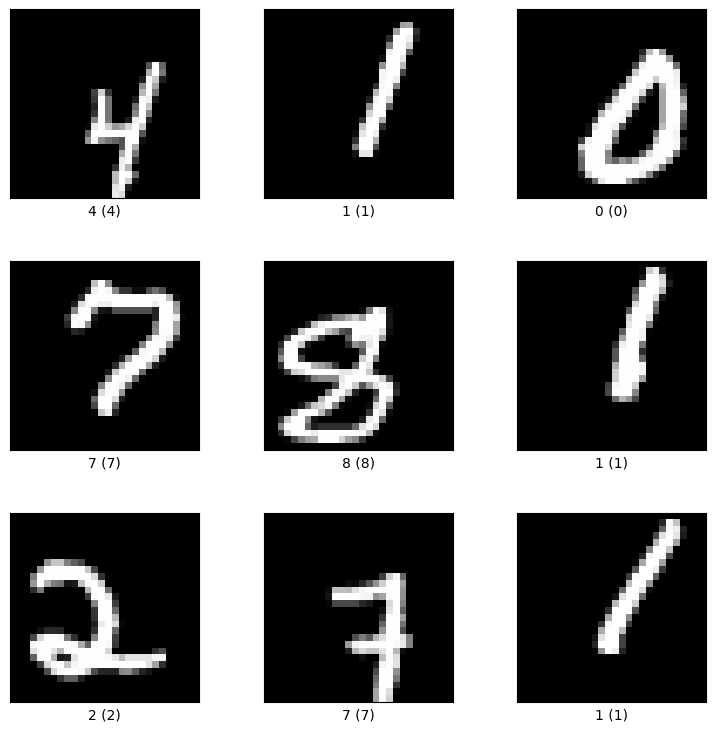
Now let’s load in a corrupted MNIST dataset.
corrupted, ds_info = tfds.load(
    "mnist_corrupted/translate",
    split="train[:2000]",
    with_info=True,
)
tfds.visualization.show_examples(corrupted, ds_info)
corrupted = corrupted.shuffle(corrupted.cardinality())
corrupted = [i["image"] for i in corrupted]
corrupted = np.array(corrupted, dtype=np.float32).transpose(0, 3, 1, 2)
print("Number of corrupted samples: ", len(corrupted))
print("Corrupted image shape:", corrupted[0].shape)
Number of corrupted samples:  2000
Corrupted image shape: (1, 28, 28)
Check for drift against corrupted data#
Test for drift between the corrupted dataset and the original reference set using all 3 detectors.
[(type(detector).__name__, detector.predict(corrupted).is_drift) for detector in detectors]
[('DriftMMD', True), ('DriftCVM', True), ('DriftKS', True)]
We conclude that the translated MNIST images are significantly different from the original images according to all 3 measures of drift.