Machine learning engineer workflow
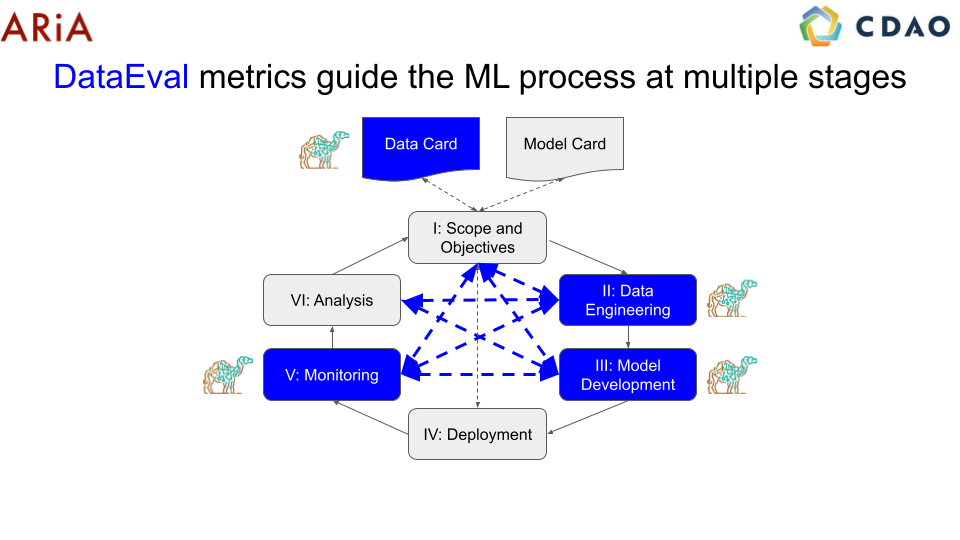
In this workflow, we will describe how a Machine Learning (ML) engineer can use DataEval, and which components of our toolkit are suitable for their use. The ML engineer interacts with DataEval at the data engineering, model development, and monitoring stages of the AI/ML lifecycle.
Data engineering
First, in the data engineering stage, ML engineers assess the quality of the data for the desired task. For example, if a higher percentage of image are difficult to classify, and the operational requirements are high, the problem may need to be reformulated or reposed, or additional data will need to be collected. The diagnostic part of this stage is sometimes called exploratory data analysis (EDA). The ML engineer can make decisions with respect to problem feasibility or data hygiene following EDA.
ML engineers can first analyze raw datasets through the linting feature.
This tool will identifyimages which are too dark, too blurry, etc. The ML engineer can then decide if these images are acceptable as is, or ought to be edited/removed from the dataset. The point of dataset linting is to identify qualitative patterns in the image data that may impact model training downstream. In cases where substantial issues exist in some images, they can be filtered out or adjusted in some way. An example output of linting can be seen below:
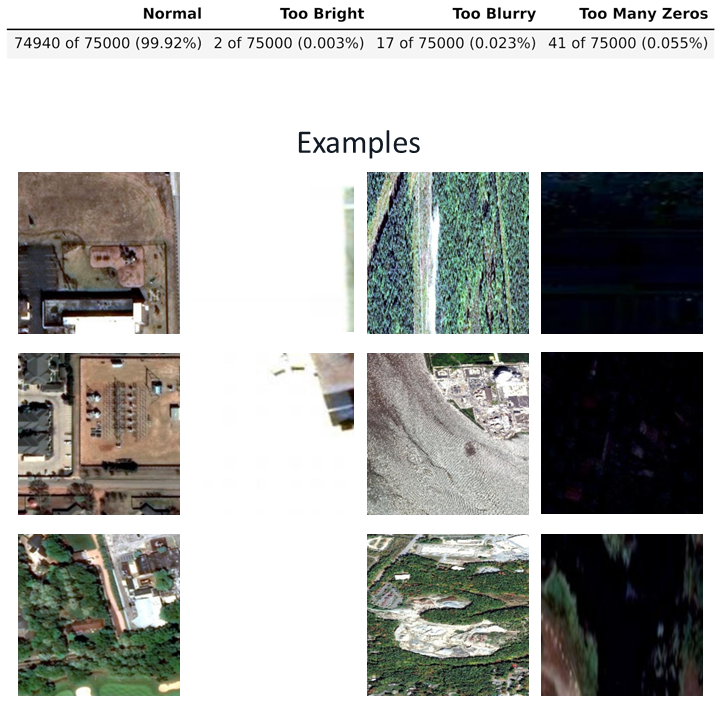
In this case, some of the bright and dark images in particular are nearly unusable, and would be very difficult for even a knowledgeable human to identify. Other quality extremes are less problematic.
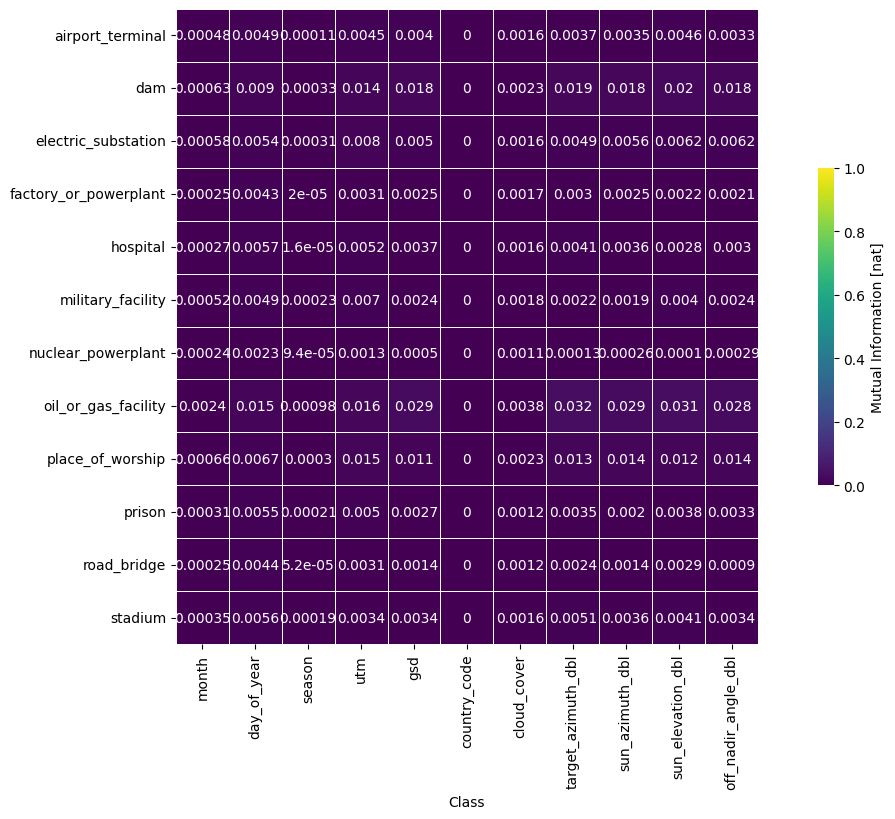
Following basic dataset linting and analysis of the images themselves, AI engineers can perform metadata analyses, checking if certain metadata factors are imbalanced or are associated with label. They can do this via the classwise balance and diversity features. The former checks if individual class labels and image metadata factors have strong mutual information, a measure of association. The latter measures if there is sufficient metadata spread within each class label distribution.
Both of these metrics tell the ML engineer if there are potentially problematic interactions between image metadata and label. High or low values for these metrics could imply systemic undersampling in certain image subcategories. In such cases, an ML engineer may want to up- or downsample certain image classes or metadata factors to maintain balance. Examples outputs for these metrics can be seen below:
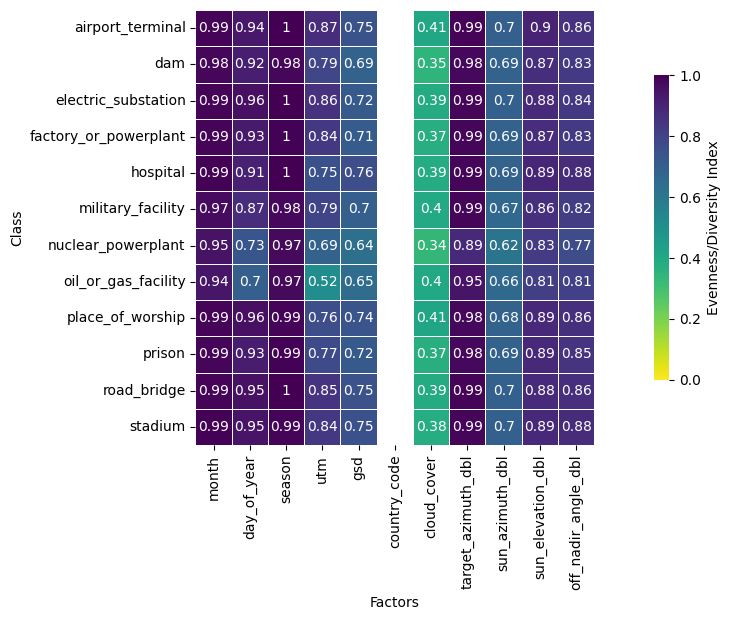
In this particular case, there seems to be quite low diversity in cloud coverage, but this pattern is repeated across all classes. This tells the ML engineer that perhaps some data preprocessing has been done with respect to this metadata factor.
Following these and potentially other analyses, the ML engineer passes off the dataset for corresponding model development.
Model development
The main responsibility of an ML engineer, and what differentiates them from others, is the selection and development of an AI/ML model for a desired task. Firstly, an ML engineer must determine if a model is sufficient for a given task. They can do this by estimating model performance on a dataset, and extrapolating that estimate out to the target dataset size. If the resulting estimate exceeds requirements, that is a good indication to the ML engineer that the model is sufficient for the task. An example visualization of this sufficiency check can be seen below:
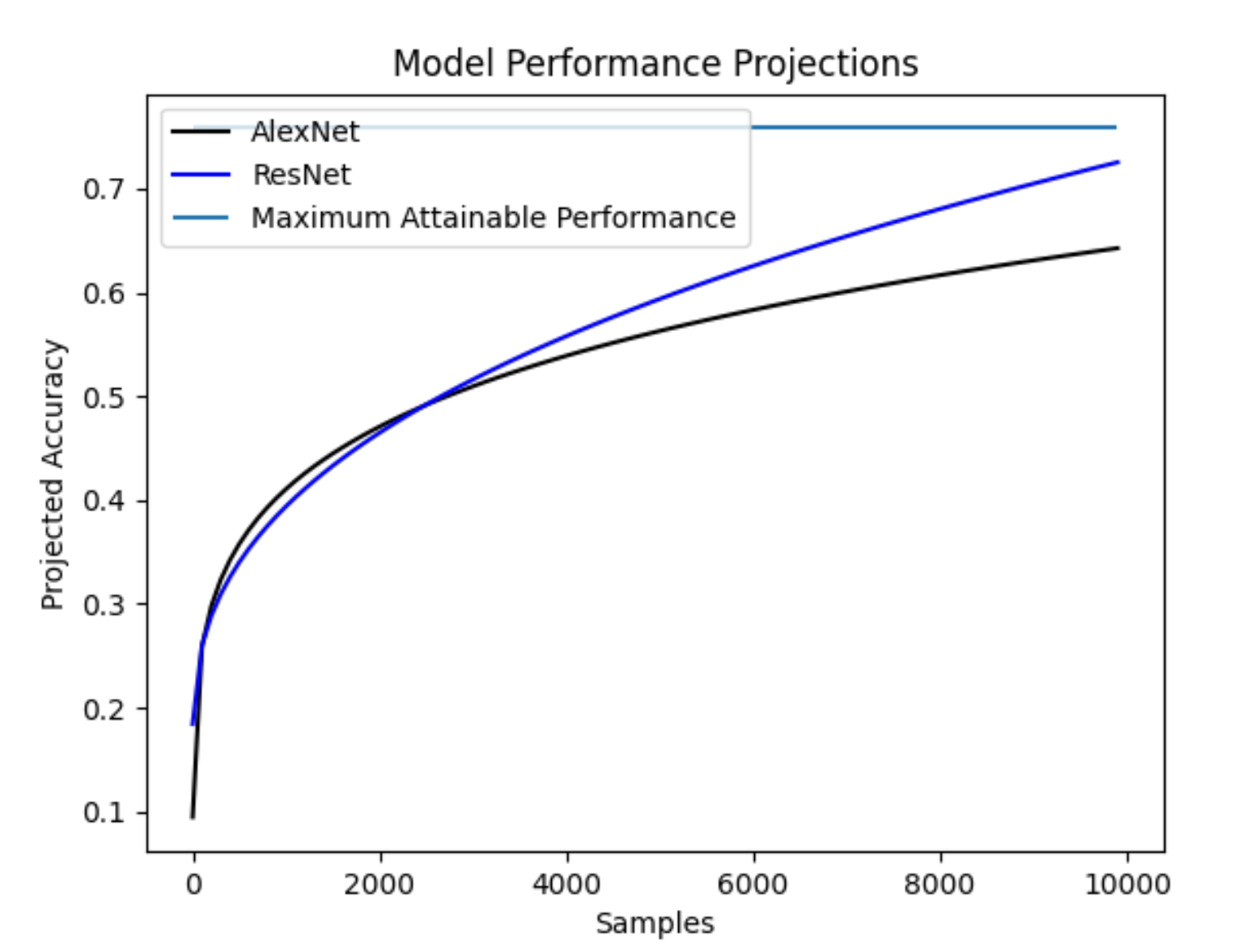
In this example, it is clear that ResNet outperforms AlexNet at a given sample size.
One other value displayed above is the maximum attainable performance. This value can be calculated by the ML engineer, and is an estimate of the maximum possible performance that a model could achieve given the complexity of the underlying task. Models can approach, but generally will not surpass, this estimate.
Following these analyses, the ML engineer would use the processed data from the above section, and the selected model from this section, to train and deploy a machine learning model to perform the desired task. This model is now intelligently selected from candidate architectures, and is trained on a dataset which has been carefully checked for potential errors/bias.
Monitoring
As an ML engineer, one is also responsible for monitoring deployed models. The purpose of the monitoring stage is to ensure that the data the model is being applied to resemble those on which the model was trained. It is not necessary for these data to be identically distributed, merely that differences between training and operational data will not affect performance. Detection of dataset drift or anomalous images can indicate to the AI engineer that additional training, or complete retraining, will need to occur in order for the model to perform similarly to test set performance.
There are several tools an engineer can leverage to analyze and evaluate the performance of a deployed model, and potential changes in operational data. The first of these tools is coverage. coverage tells the AI engineer which images in the operational set have few other images which are similar to it. Such images can tell an ML engineer which image factors may be undersampled in operational data. This is critical as regions of the image space that were densely sampled in the training data, and therefore fit quite accurately, may not correspond to regions that are densely sampled in the operational dataset. Such a difference can lead to performance degradation even if the operational environment itself has not changed. An example of a coverage output can be seen below:
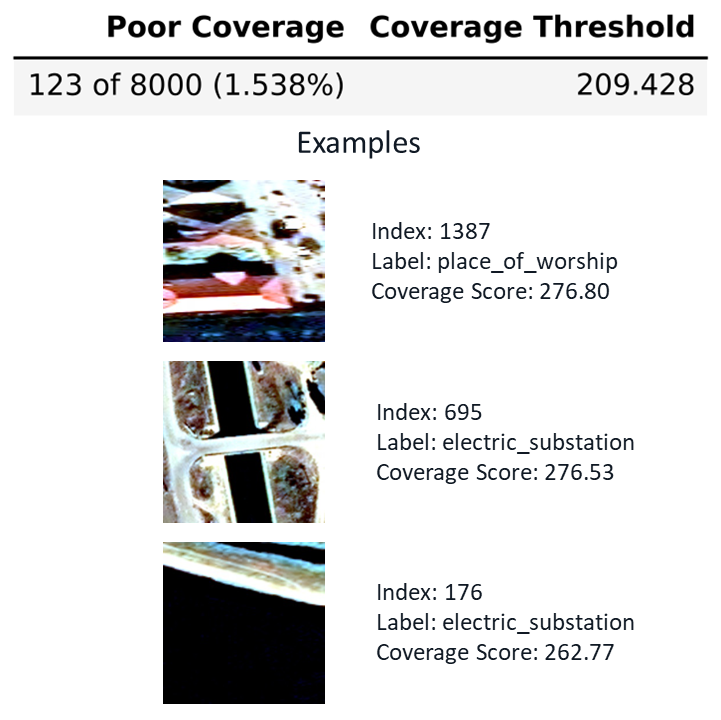
In this example, the ML engineer was able to identify high-contrast electric substations as a potentially problematic subclass in the operational dataset.
Another image assessment tool is out of distribution (OOD) detection. This tool detects images which look entirely dissimilar to those on which the model was trained. Such images can indicate to an ML engineer that there has been a qualitative shift in image distribution, or that a new, operationally relevant class has emerged. An example OOD output can be seen below:
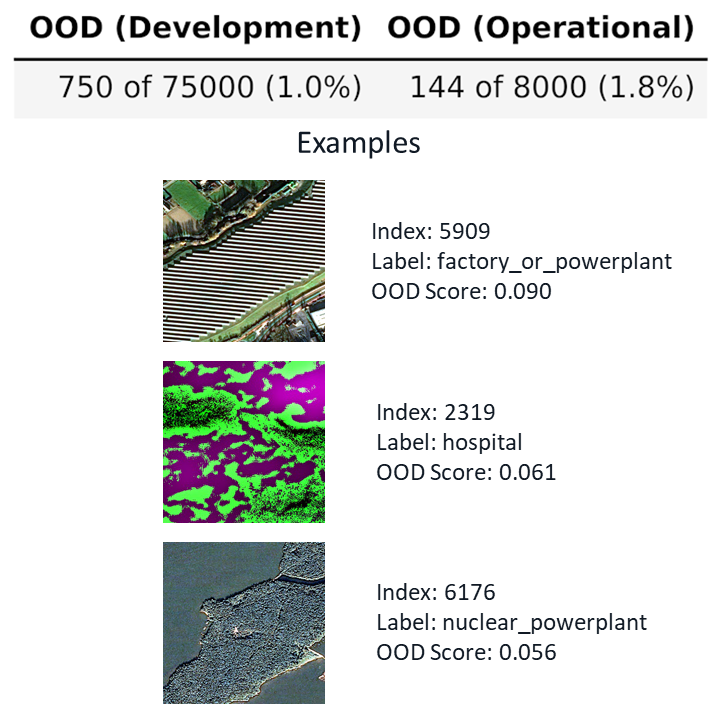
Here, we can see that a new type of powerplant, a solar farm, has emerged in the operational dataset. This type of powerplant was not present in the training set, and is therefore flagged as out of distribution. This would constitute a retraining event for the ML engineer.
Finally, the ML engineer can look at overall dataset drift. DataEval has several tests which determine if the operational dataset is significantly different from the training data. Such changes are known to be associated with performance degradation, so the ML engineer would trigger retraining as a result of significant drift. An example output can be seen below:

These results indicate that the operational set has shifted substantially, a result confirmed but some of the analyses above. Such indications should tell the ML engineer that the model should be retrained.
With all of these tools in DataEval, an ML engineer can conduct analyses at multiple stages of the AI/ML lifecycle.